Workflow & Automation


A client calls in a panic.
They got a notice. The IRS is collecting. They owe more than they can pay, and they do not know what to do. They found you, booked a consultation, and are sitting across from you, ready to hand over their entire financial life.
And you say: "Great. Send me your documents."
Three weeks later, you are still waiting on a bank statement from 2022 and a pay stub from a job they forgot to mention. The case has not moved. The IRS has not paused. And your client is texting you every 4 days to ask if anything is happening.
This is not a rare situation. For most tax resolution professionals, this is the case. Repeatedly. Across multiple clients. At the same time.
The problem is not that clients are difficult. The problem is that most practices do not have a real tax client organizer built for resolution cases. They have a vague checklist that worked fine for tax prep and falls apart entirely when the IRS comes knocking.
Here is what actually needs to be in a tax client organizer for IRS resolution. And here is what happens when you have a system to collect it.
A tax organizer is a structured document or system that tells you exactly what information and documents you need from a client before you can do your job.
For general tax preparation, that list is fairly predictable. W-2s. 1099s. Receipts. Prior year return. Clean, consistent, repeatable.
IRS resolution is a different category entirely.
When a client owes back taxes, is facing a levy, or is negotiating an Offer in Compromise, the information you need goes far beyond income documentation. You need a complete financial picture. Assets. Liabilities. Monthly income and expenses down to the dollar. Bank account history. Business ownership. Property. Vehicles. Retirement accounts. Loans. What they own, what they owe, and what they spend.
The IRS uses Form 433-A and Form 433-B to evaluate a taxpayer's ability to pay. Those forms are detailed. They ask about everything. And if the numbers you submit are wrong, or incomplete, or inconsistent with what the IRS already has, the whole case can be delayed, rejected, or reopened.
That is why a tax client organizer for resolution cases is not just a nice-to-have. It is the foundation on which the entire case is built.
According to the IRS Collection Financial Standards, the agency uses specific allowance figures for living expenses when evaluating what a taxpayer can realistically pay. If your client's organizer does not accurately capture their actual numbers, you are going in blind. And guesswork in IRS resolution is expensive.
Think of this as the master list. Not every case will require every item. But every item on this list has the potential to matter. A good tax resolution intake process starts here.
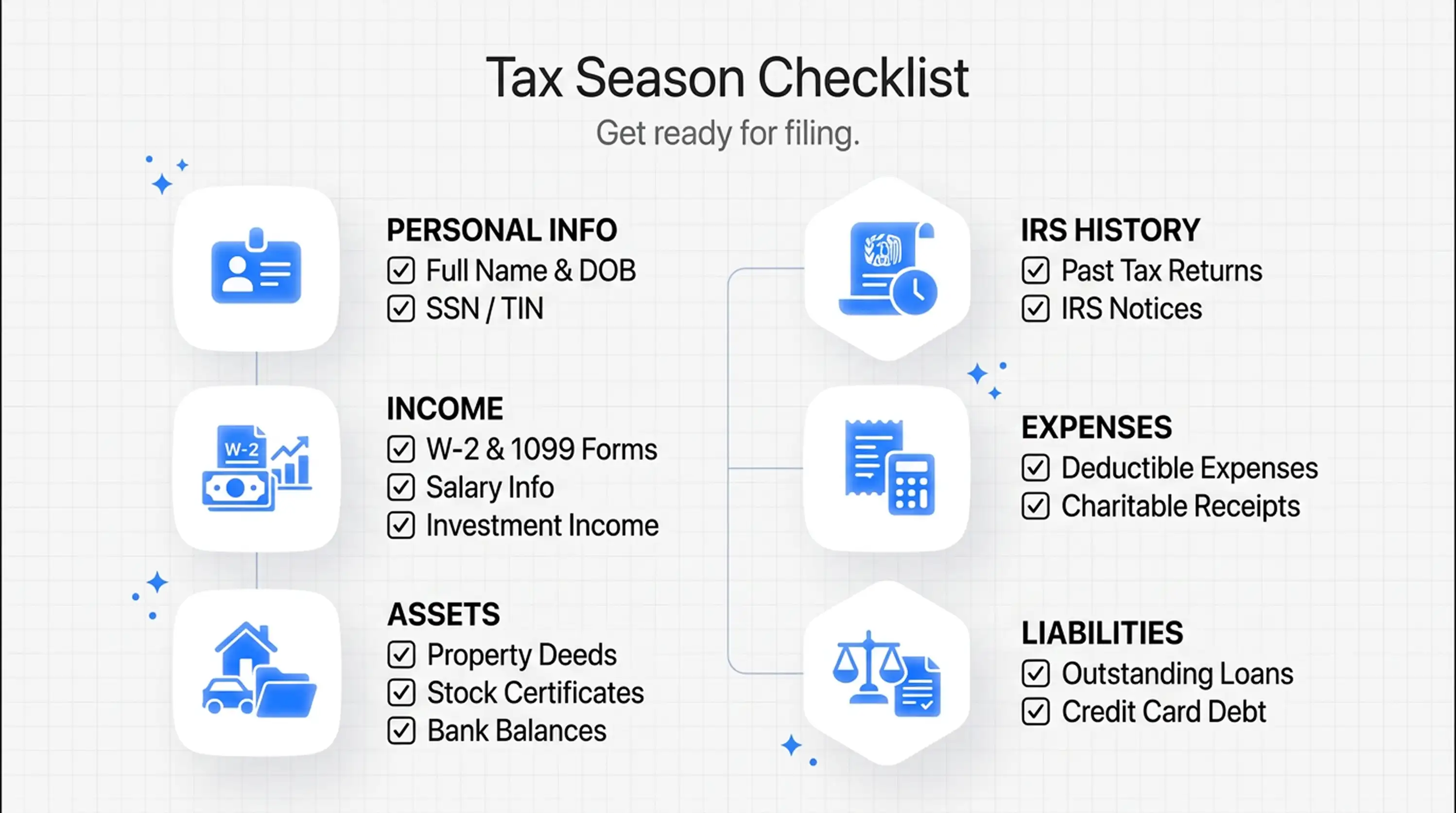
This is where most organizers fall short. You need actual numbers, not estimates.
This is the complete picture. And the faster you collect it, the faster the case moves.
You can know every IRS resolution strategy in the book. You can negotiate installment agreements and Offers in Compromise with your eyes closed. But if it takes six weeks to get a client's documents organized, none of that expertise matters yet.
Document collection is the bottleneck that quietly kills case momentum. And it happens for a few predictable reasons.
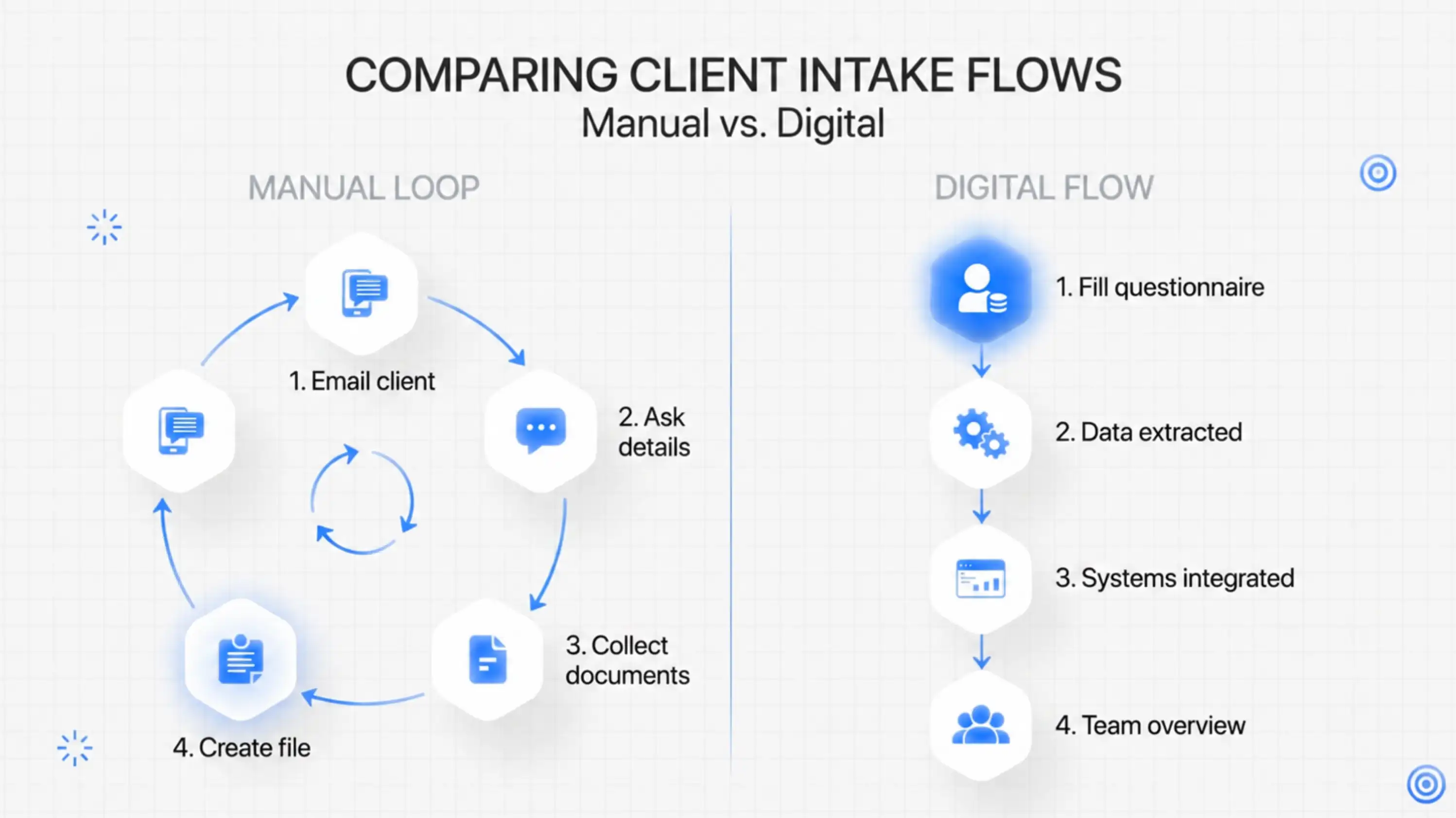
Clients do not know what they need to gather. They send what they think you need, which is usually incomplete. Then you send a follow-up. They send more documents. You realize something is still missing. The loop continues.
Documents arrive in scattered formats. A PDF here. A photo of a bank statement there. Something scanned sideways. Nothing labeled. Everything in a folder called "Tax Stuff."
There is no clear system for what has been received versus what is still outstanding. The resolution professional is manually tracking this in their head, or in a spreadsheet, or in a color-coded email folder that made sense in January and makes no sense now.
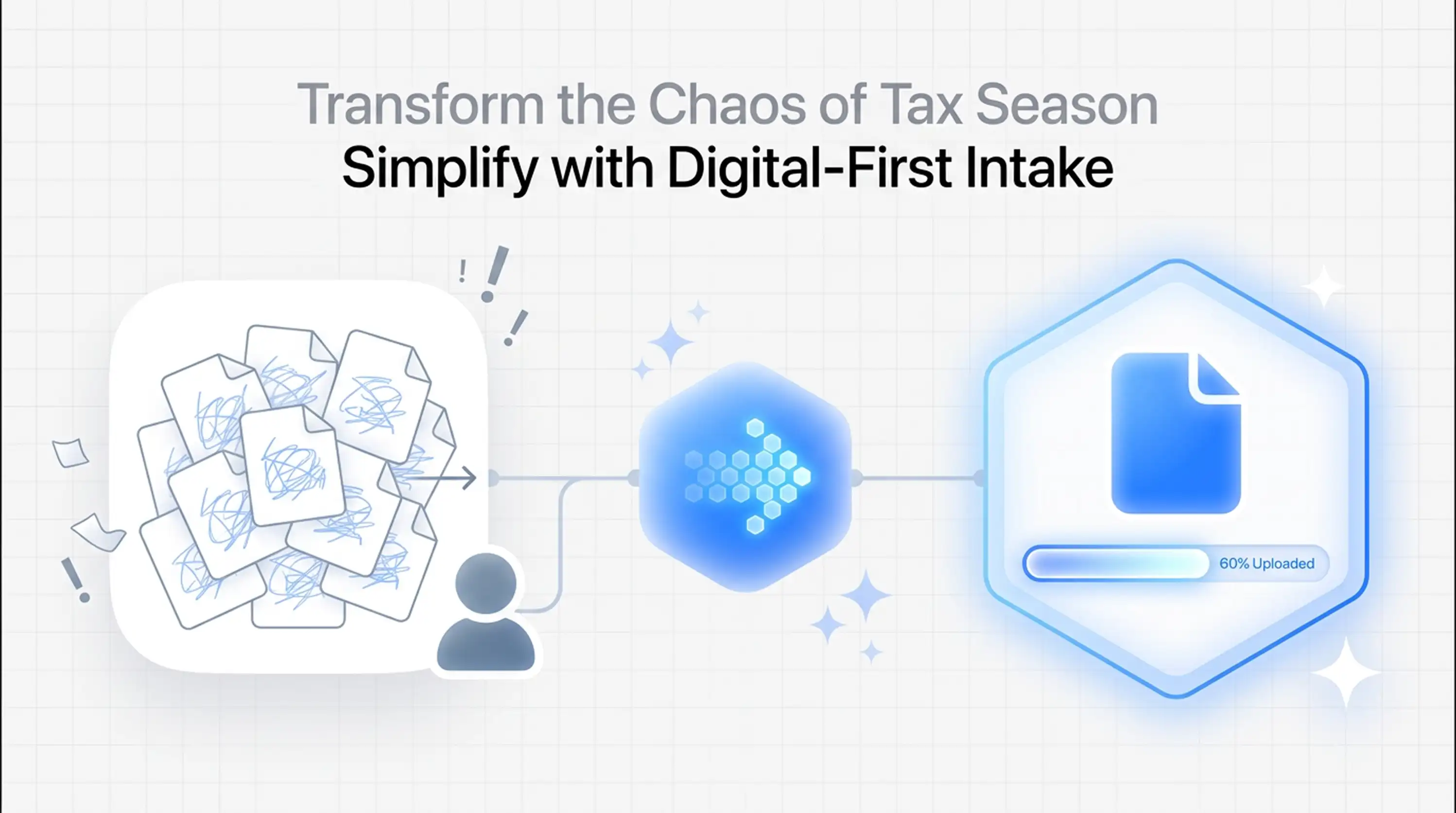
The solution is not to send a more detailed email. The solution is to build a structured, client-facing document collection process in which the client knows exactly what to upload, uploads it securely, and you are notified the moment it arrives.
That shift alone, from email-based document collection to a dedicated intake system, changes the pace of every resolution case you work.
Here is the part of the tax organizer process that most practices still handle manually, and it takes more time than they realize.
Once you have the client's documents, someone has to enter that information into the IRS financial forms. Form 433-A. Form 433-B. Every number, every account, every monthly expense, entered by hand.
If anything changes, you go back and re-enter. If you catch an error in the original documents, you re-enter again.
The IRS Financial Questionnaire-to-pre-filled IRS forms approach changes this entirely. You send the client a structured digital questionnaire. They fill in their financial information directly. You review it. When it is approved, it auto-populates into the IRS financial forms inside your case management system.
No re-entry. No transcription errors. No going back to recheck whether the client's monthly mortgage payment was $1,850 or $1,580.
According to the American Institute of CPAs, reducing manual data handling is one of the highest-impact improvements a tax practice can make. In resolution work specifically, where the accuracy of financial disclosures can determine whether an OIC is accepted or rejected, this is not just efficiency. It is risk management.
Most practices treat the tax client organizer as a step before the case starts. Something that happens in intake, then gets filed away.
But in resolution, the client's financial picture is not static. Income changes. A client sells a car. They take out a loan. Their monthly expenses shift. And if your case management system is not integrated with the document collection process, you are always working from a snapshot that may already be outdated.
When your tax organizer is embedded in your case management workflow, a few things change.
Every document the client uploads is tied directly to their case file. Nothing is sitting in an email thread or a shared Google Drive folder with a vague name. It is on the case, attached, visible to every team member with access.
The status of document collection is visible at a glance. Which items have been received. Which are outstanding. Which the client has been reminded about. No one has to ask. No one has to check.
When the financial information is collected and approved, it flows directly into the IRS forms without manual re-entry. The case moves faster because the intake process is not a separate, disconnected task. It is part of the case itself.
This is what purpose-built tax resolution software for accountants actually looks like in practice.
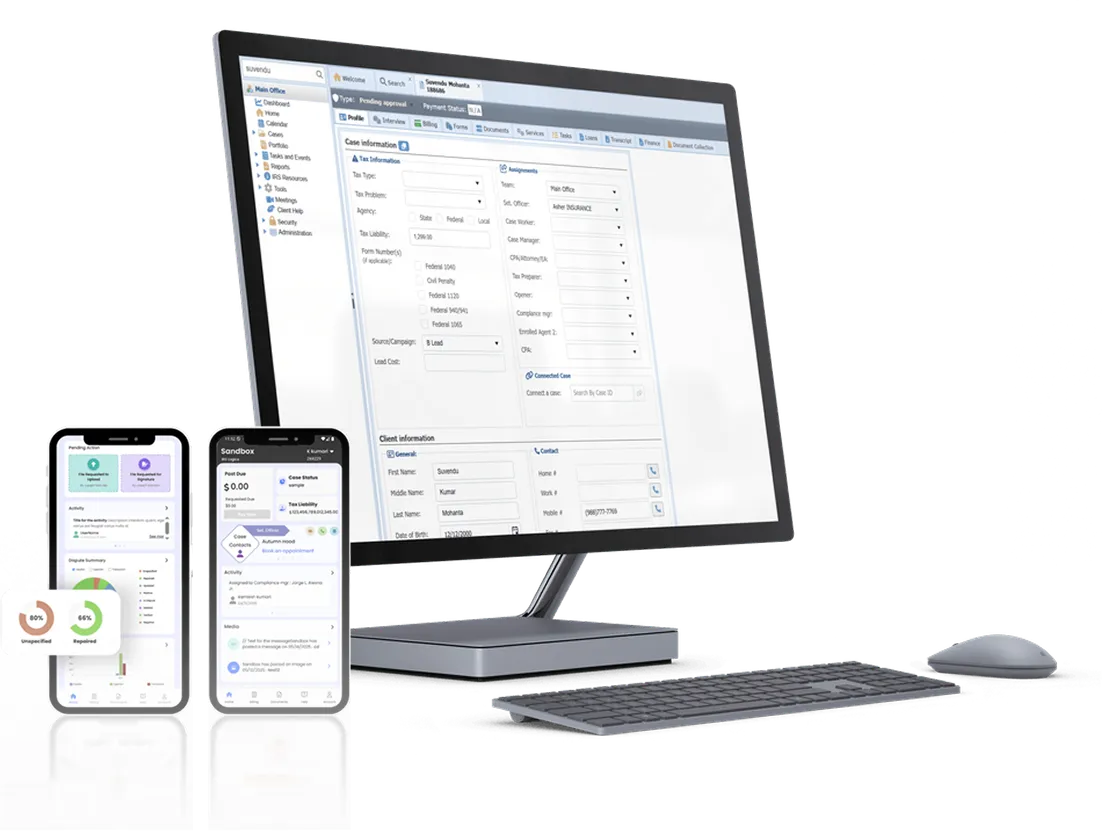
If you are a CPA, enrolled agent, or tax attorney handling IRS resolution, the way you collect and organize client information before submission determines the pace of every case you work. IRS Logics is built specifically for this, and it is the only all-in-one platform where your tax client organizer, document collection, financial intake, and IRS form generation live in the same place.
The Document Collection Tab provides a structured, client-facing intake process in which every document category is defined, the client uploads directly, and you are notified the moment something arrives. No email threads. No "did you get what I sent?" No manual tracking of what is missing. The Financial Questionnaire feature lets clients fill out their financial information in a guided digital format. Once you approve it, that data auto-populates directly into the IRS financial forms in Logics, cutting hours of re-entry and eliminating transcription errors that could affect a case's outcome.
Every document, every financial disclosure, every form lives on the case file. Your team sees the full picture. Your client has a secure portal to upload, check status, and communicate. And you have the visibility to know exactly where each case stands without having to chase anyone. That is IRS Logic's advantage for tax resolution professionals who take their intake process seriously.
A tax organizer helps collect all the financial information needed for an IRS resolution case, including income, assets, liabilities, expenses, and tax history. This information is used to prepare forms like 433-A and 433-B.
The goal is to gather complete and accurate information before submitting anything to the IRS. A well-prepared organizer reduces delays, errors, and rejected submissions.
A secure digital intake process is the most effective approach. It keeps documents organized, tracks what is missing, and eliminates the back-and-forth of email collection.
Missing documents can delay the case, trigger additional IRS requests, and increase the risk of rejected applications or inaccurate resolutions.
A digital questionnaire collects financial information in a structured format and can automatically populate IRS forms, saving time and reducing manual errors.
The resolution strategy only works if the intake is done.
You cannot negotiate accurately with the IRS if you are working from incomplete financial information. You cannot file Form 433-A confidently if three documents are still missing. And you cannot move a case forward if you are spending two weeks just trying to get organized.
A real tax client organizer, built into a real case management system, is what separates the practices that close cases efficiently from those that are always a document away from making progress.
Get the intake right. Everything else gets easier.
All
Tax Software
Workflow & Automation
Industry News
Resolution Tips
Tax Resolution Marketing
Lorem ipsum dolor sit amet, consectetur adipiscing elit. Suspendisse varius enim in eros elementum tristique. Duis cursus, mi quis viverra ornare, eros dolor interdum nulla, ut commodo diam libero vitae erat. Aenean faucibus nibh et justo cursus id rutrum lorem imperdiet. Nunc ut sem vitae risus tristique posuere.


Share this article directly by email. Simply enter the recipient’s details below.

Article has been send to you.